
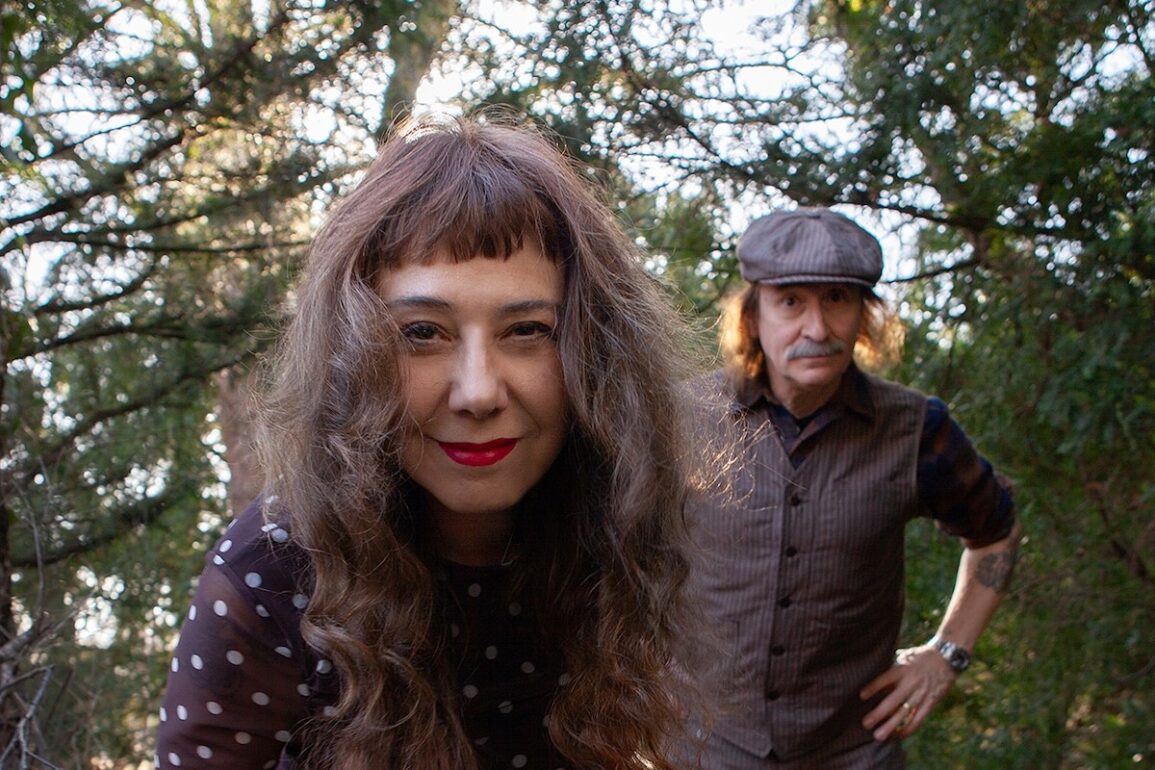
Cover Photo Credit: Mara Von Kummer
What does it mean to belong somewhere? And what if home is more than just four walls? With their album Lichtung, Danielle de Picciotto and Alexander Hacke of hackedepicciotto wander through the boundaries of language, sound, and imagination, while reflecting on their own journey from nomadism to settling down. In this conversation, we talk about the evocative power of words, dreams, Tarot, the spectre of fascism, and art’s ability to spark new thoughts in the minds of those who encounter it.
Lichtung is a record that explores the limits and possibilities of the German language. I still don’t know the language very well, but long before I considered learning German or moving to Berlin, kopfkino was already one of my favourite words in any language. Would you say Lichtung is a good record to daydream along to, and would it make you if I say it is a good example of a kopfkino?
Alexander Hacke: Certainly. We always considered our music very cinematic. In fact, in the beginning, we called it “cinematic drone,” but if you google “cinematic drone”, it leads you to those flying cameras. So we decided to change that name. What we do is supposed to be evocative, and to create images and concepts.
Danielle de Picciotto: Yeah, we don’t consider ourselves entertainers. We basically do art to express thoughts that we have and to somehow, hopefully, make thoughts happen in the listener. Not necessarily the same ones we have, but that it somehow generates something. If you say it generates a kopfkino with you, we’re very happy, because that’s what we think is the responsibility of art: It creates new thoughts in the listener’s head.
Could I ask each of you to share one sophisticated or particularly beautiful German word, along with its meaning, that you would like to introduce to our readers?
DDP: Interesting question. I personally love vogelfrei, which is also a title of one of the songs, because it has so many meanings. I love the word frei, free, and I love birds, vogel (in singular). Originally in Greek, they were considered the messengers to the gods. In that one word, there’s so much symbolism because on one hand, if you just hear the word, you could think it means “as free as a bird”, but the German interpretation of it is also being outside of the law and being alone outside of the law, and that people have the right to attack you because you’re outside of the law. I think that’s a very interesting thought, because it means that if you don’t follow the standard laws, people are allowed to attack you. That is a very interesting thought because it means that you’re alone. That’s basically the situation of everybody that doesn’t agree with current regulations. So I really love that word.
AH: It literally means that if you fall, the birds are free to pick on you. [laughs.] It’s not “free as a bird”, but “free for the birds to feast on.” That’s what it actually means.
DDP: I love the German thing of putting two words together. I love that you can do so much with that.
Do you have a word to add, Alexander?
AH: There’s lots of words. The funny thing is that Danielle has very physical aversion reactions to certain words I use. She goes like, “No, don’t ever say that again.”
It is a very evocative language.
AH: Yeah, but the German language is also so charged with all these historical connotations by society standards. It’s a very classicist language, if you will. So many words indicate that you are from the lower classes, and many others are assigned to higher classes in society. In fact, in the olden days, even up to the emperor’s days, German was considered a lower class language. French was the aristocratic language in German high society, strangely enough.
DDP: So what’s your favorite word?
AH: What’s my favorite word?
DDP: He’s trying to get out of it. [laughs.]
AH: Hey man, you know, whenever you ask me any superlative question, I just draw blanks. I can’t think of anything. I don’t know my favorite movies, I don’t know my favorite music… I like the word see. [all laugh.]
I want to talk about the idea of “settling down.” To me, settling down somewhere is not only a physical act; there is also a kind of mental peace attached to it, a feeling that could perhaps be described as happiness. When I was a teenager, my father used to say: “There are two secrets to finding happiness in life: to be with the person you love, and to do the thing you love.” You seem to have both of these things. Did that make it easier for you to settle in Lichtenrade mentally, as well as physically?
DDP: It’s interesting because I just told Alex 10 minutes ago that I feel like my soul has just arrived here, after having moved here a year and a half ago.
There’s many different aspects to settling down. I think in that respect, we’re also very different, Alex and myself. I grew up as a nomad, because my father was in the American army and we would move every year. So the first time I actually ever lived anywhere for a little longer was in Berlin, but I was already 25 when I moved there. So for me, traveling is actually a more natural state, and settling down is always very difficult. When we moved here, I felt really uncomfortable, until yesterday. I ask myself why, and I believe in this thing that the soul takes longer to settle. Like when you have jet lag after you fly somewhere, and you feel you are not really there. I have that very strongly. Settling down is a completely different state of mind than traveling. When you’re traveling, your senses are much more directed to the outside. You have to see in what country you are, what the habits are, what the climate is. You have to learn new streets. You have to learn about the place you’re in to be able to survive.
When you settle down, it’s more about yourself. It goes more introverted, because it’s always the same place. Then the thing that changes all the time is yourself, with your moods, with your interests, with your attention. When you’re settled down, it goes deep down. When you’re traveling, it stays a little superficial. It’s not as intimate. They’re very different states of mind. You often hear about the frog perspective and the eagle perspective. When you’re traveling, you have the eagle perspective because nothing’s really close and you’re just skimming. You see different cultures, you hear different languages. When you’re at home, you see it from a frog’s perspective, because everything’s very close.
I think both perspectives are very important. That’s why it’s good for people to travel, for people to experience new things, because it opens borders. Stuff like racism or discrimination gets cracked open, because you have to adapt to your surroundings. The more you are only at home, your walls get thicker and thicker and you only see your perspective. For me, as I mentioned, it’s easier to be a nomad. I don’t need to have things. I’m very happy just having a suitcase. With Alex, I think it’s different..
AH: Well, for me, I grew up not very far from here. I learned how to ride a bicycle in these streets. My entire life, I’ve been touring with bands. I started that when I was a little teenager, but I would always have a place to withdraw to. When we were nomads, that place wasn’t there. I had to adapt to the situation that there was no off time. I had to be always aware.
For me, it really is very different to Danielle’s perceptions because as long as we were traveling, as long we were nomads, my senses were very occupied with navigating myself through the world. Now that we have a place to withdraw to, a sanctuary, I get to really observe what is going on in the world, because I don’t need to navigate anymore. I read the paper with much more awareness that nothing is permanent. Even with this settling down, it doesn’t necessarily mean that that is the end of things, particularly with the way the world is going. Who knows, we may have to escape from fascism or whatever that is coming.
At the end of your video for “Wiederbelebung,” you each pick up a Tarot card: the King of Swords and the Queen of Wands. Do you think those cards resonate with your respective personalities?
DDP: We work a lot with Tarot.
AH: Yes. We study the Tarot and the Kabbala and stuff like that, but I am not sure if it was actually even Tarot cards that we’re picking there. I think it may be Scopa cards.
DDP: Yes.
AH: It is an Italian card game. You could play Scopa with the minor keys of tarot because they have the court cards and the number cards.
DDP: But we did choose them on purpose, the king and the queen because it means that in this place that we are in, we are now in charge, which is different than if you’re a nomad, because when you’re a nomad, you always have to adapt. The king and queen, they’re on their thrones and they have their kingdom. Not that we want to control, but we have to be in charge of this place that we have decided to live in. It’s a very different attitude than being a nomad, because you cannot be in charge there. You just have your suitcase.
That moment in the video comes at the end because wiederbelebung means resurrection, coming to life again. We have come to life again in a new surrounding in a new life. We are in charge for this. We cannot just say, “Oh, we’re not responsible.” The king and the queen means being responsible.
Do your dreams ever inspire your songwriting or your creative process?
AH: For a while, I was obsessed with my dreams. From 2014 to 2016, I would write down my dreams and I would consciously train lucid dreaming. That’s the state where you, in your dream, realize that you are dreaming, and then you can control your dream and you do that by first learning how to remember your dreams. It is quite an intense process, because you have to do it in a way that you don’t ask for. You don’t say “I want to remember my dreams,” or “I wish I could remember,” “I am remembering my dream.” I stopped doing that after two years because I just didn’t sleep very well anymore. [laughs.]
I am very aware of the fact that dream experiences are as real and as much part of our makeup as waking life, what our psyche and what our soul are made of… I still cherish the dream state very much. Even though I’m not as focused anymore into transporting the actual information into this realm, It’s very important. One technique that you do when you learn lucid dreaming is that you look at your hands and you concentrate on the fact that you are awake. It’s a great meditative practice to really realize whether you are awake, or awake.
DDP: I don’t really dream, sadly. It happens very rarely, and usually they’re nightmares. I’m actually more into manifesting things. I’m more about making my dreams. The things that I would like to manifest, to think about them and to manifest them, that’s what I’m usually working on. This place that we have now is a result of this manifestation in a really magical way. We both worked on manifesting, visualizing things, and it was crazy, because this place is exactly the way we visualized it.
With our music and with our lyrics and our songs, we try to do the same thing. We try to manifest certain things which we think are important. Generating kindness, generating love, generating peace, generating positivity… So that the people who listen to our music are enveloped in this, and maybe it has an effect on how their life treats them.
You can check out hackedepicciotto’s Bandcamp profile here.