
Cult post-rock duo Hammock are preparing to release their new album The Second Coming Was a Moonrise on May 22. On the occasion of this record -as mesmerizing and profound-sounding as ever- we sat down with one half of the band, Marc Byrd, for an intimate conversation over Zoom that was at times dark, yet equally uplifting.
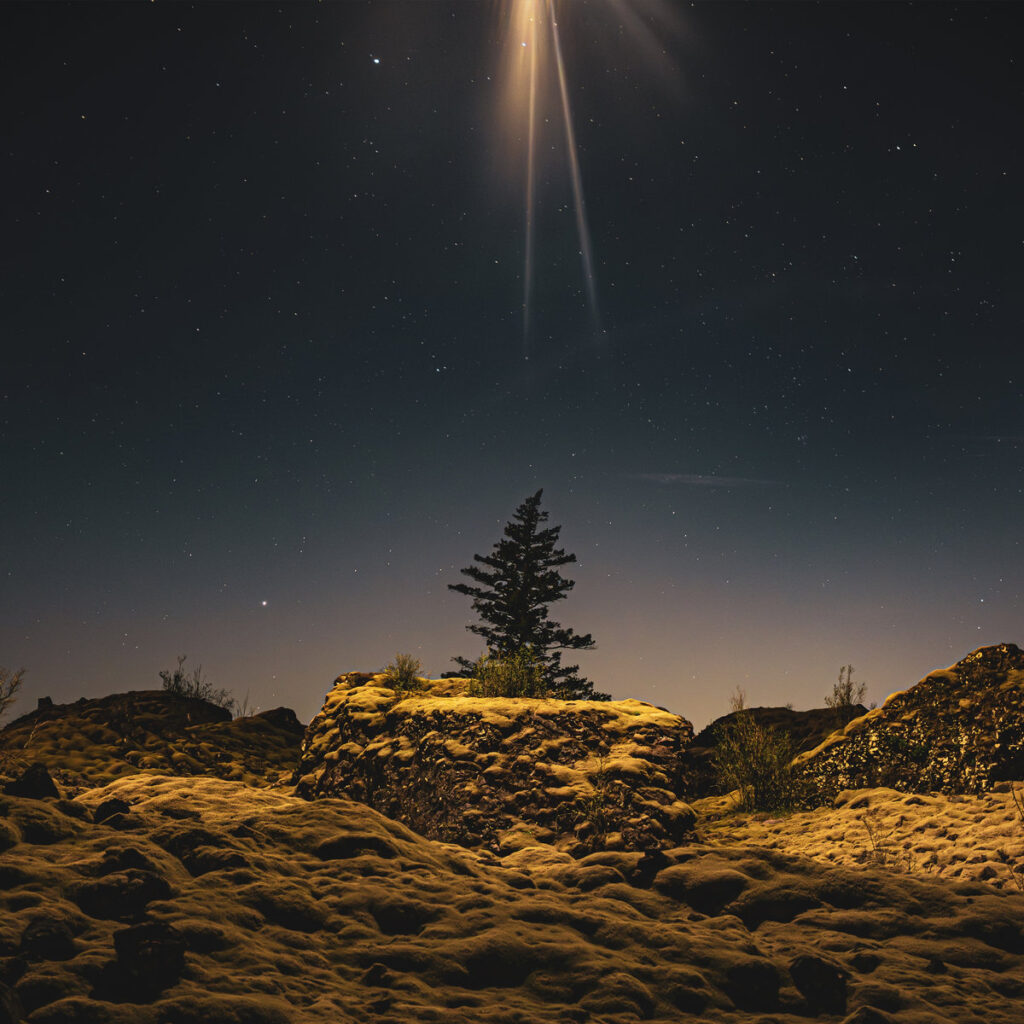
The cover art for your new album, The Second Coming Was A Moonrise, looks really cool. Do you know if what we see there is an actual place or not?
Marc Byrd: Thank you. I’ll let Stephen Proctor, who did the cover, know. Yeah, it’s an actual place in Washington State that was used by Native Americans for ancient rituals. Only the locals know about it. I’ve never been there, but Stephen has. It was a total setup with the shot, and the light that’s coming down is actually a drone above it.
The album title is connected to one of your past memories involving psychedelics, in which you witnessed a moonrise with a friend and momentarily thought you were witnessing the second coming of Jesus Christ. Can you elaborate on that for our readers?
Marc: My journey with psychedelics has deeply enhanced my life. For me, they’re like a touchstone. I think we all learn slowly and forget very fast, so I do think that a little parting of the veil, shall we say, that looks into deeper meaning, makes us say, “I don’t know everything that’s going on.”
That particular story behind the album title, I’ve been hanging on to it for a while because I’ve always thought it was kind of funny. Emery Dobyns, who mixed our record and is a good friend of mine, was raised in New York, and he’s Jewish. I asked him, “If you were with me, would you have seen the same thing that me and my friend saw and thought that was the second coming of Jesus?” He was like, “Absolutely not. No way.” [both laugh.] What I’ve learned is that a lot of us don’t actually see what we see. We see what we’ve been taught to see. We see what we think we’re seeing. That conditioning exists even within relationships with other people.
The story behind the title is great. We were watching the scenery and the hills started glowing. The light gets bigger and bigger and then, the next thing you know, my friend is on his knees, like, “Oh, God, please, no, no, no!” Then I saw this little sliver of light rise above the hills and realized it was the moonrise. We had a big laugh about it, but when I look back on that, based on what psychedelics or any of those meta experiences can teach me, I realize I just get used to seeing things the way I see them, and I don’t really see them anymore. If you’re raised in a small town, you no longer notice its architecture. You just get used to it. I think it’s the same thing with anything in existence. We just get used to being alive without ever reflecting on the experience.
It is crazy that we’re alive, you know? The chances of everything working out the way it did to give us life are pretty astounding. I just forget sometimes that I’m on a spaceship floating around, and I get to see a moonrise. If I could stop forgetting these experiences, I might be able to have a better relationship with every moonrise and sunset that I see. But we take those things for granted, so we don’t really see them anymore. With what’s going on in the US right now, everybody is just seeing things the way they want to see them or think they see them. What’s missing is the actual ultimate reality. It’s just our conditioning and our ways of seeing that teach and tell us what we’re seeing.
As a huge The Flaming Lips fan, I was very happy to see that you collaborated with Wayne Coyne and Steven Drozd on the track “Chemicals Make You Small”. I know that Wayne has a small-town Catholic upbringing and experimented with psychedelics in his youth, just like you. Do you think the sentiment in that song resonated with him because of that?
Marc: I originally just asked them to sing on the bridge, and then they ended up singing the whole song. Steven ended up adding string pads and changing the arrangement a little to cut it shorter and add some keyboards.
In a small town, if you start doing chemicals and get into that kind of thing, it can turn on you real quick, because there’s nothing there except escape. All you want to do is escape, so what ends up happening is that what you think is enlarging your reality can bite you and actually make your existence much smaller. Addiction is a way of being isolated. I knew that Wayne had a brother who had dabbled in all of that. People think that Wayne is just a druggie or whatever, and that’s just not true. He has a really healthy fear of it, from what I understand. Steven, on the other hand, has had his own problems with addiction in the past.
Them being from Oklahoma and me being raised in Arkansas, I’ve always felt a kinship with them, with both of us being the freaks of the town. You like poetry and art and The Cure, and you can feel very lonely. You find something like psychedelics, and it opens up a new world for you, but I know that it can also have a negative effect, because I end up thinking that’s what feeling good is, that you need a chemical to feel that. I have plenty of friends who have died from that kind of thing. It really is rooted in the experience I had in the small town where I was raised, where someone was face down in the backseat, tripping out and thinking they were literally dead. I just started thinking more and more about that, and I thought, “Well, in a way, addiction can make you like a walking dead person.” You just lose that vitality of life. You never intended for that to happen. Something made you feel so good and probably helped you deal with feeling like a weirdo in a small town, but in the end it bites you back.
I think a lot of the lyrics from their last record American Head are essentially talking about what you just told me.
Marc: Oh, yeah, totally. And I really resonate with that. Wayne worked at Long John Silver’s one time. I worked in a restaurant too. It was a fast-food pizza place, because that’s what a small town offers you. If you devote your life to music and something creative, there aren’t a lot of options when you’re raised in a small town. So the fact that Wayne ends up in music and I end up in music and we both end up doing our own thing, I just feel a real kinship with that, you know?
If you were to select two tracks from The Second Coming Was A Moonrise, one easiest and one hardest to produce, which two would they be?
Marc: I would say that “Sadness” was the easiest one to produce. When you hear that, you hear early Hammock too. It has that quintessential kind of sound. The hardest one was the title track, because it’s a real journey. We were just recording two days ago, going through some of the isolated tracks that we’re going to post online. Originally, that wasn’t meant to get as big as it did. The real struggle was figuring out how much was enough to pile on, and how much we should peel back. It took a long time to get that track into shape. “Everything You Love Is Buried in the Ground or Scattered into Space” was also like that.
Do you keep dream journals, and do you think your dreams inspire your songwriting in any way?
Marc: No. [both laugh.]
That’s a legit answer.
Marc: I wish I could answer that differently. I actually tried journaling dreams for a while, and I only remember snippets. A lot of times, my dreams are not kind to me. Rarely do I have a beautiful dream. There’s one that I remember vividly where I was in a desert dancing around, and I struck the ground and it opened up with water. That was a really beautiful moment. But a lot of them are… Yeah, I don’t remember most of them, and when I do, they’re not great. I had a nickname growing up at times: Dark Marc. Maybe there are things in my mind that I still need to wrestle with and come to terms with.
Where did that nickname come from?
Marc: I could change the mood when I walked into a room. I didn’t say a word, it was just my body language. I was a little gothy. I’ve changed now, but if you had talked to me then, I would have said, “This world is a graveyard. You’re going to be dead much longer than you’re alive.”
We are going through a really dark period in world history. Apart from music, do you have detox routines where you relax to make this world weigh less on you?
Marc: I meditate. I’ve meditated for a long time. Once a year, I go out to a monastery in Big Sur. It’s off the grid. I don’t like having to participate in anything with the monastery, but I get a private hermitage. Some people have gone there to write famous books. I’m going there again very soon to unplug. The first two days you’re there, it’s dead silent, and you don’t have any connection with the outside world. Nothing works. How many times I grab my phone is very revealing to me. In those first two days, my head feels like a hornet’s nest a little bit, but then the silence settles in and you settle into the silence, and it’s beautiful there.
I remember how, for our album Universalis, I had been there for about four days when it just hit me: the sequence of what the album needed to be. Immediately, boom, there it is. Those touchstone places where you can unplug and find a place of clarity, I call it “the center”. If my center holds, I can get through some chaos and I can be okay not being okay, but I have to work on staying connected with that center.
I read a lot. My wife is great, and my dog is awesome. We’re very close with our dog; she’s practically like a kid to us. A lot of times it’s nature, though, that can get me back to a place of remembering. Because when I get in a mood or whatever, life gets small. But if I can find a place or space, whether through meditation and creating an inner openness or going out into nature, I feel panoramic. I feel more open. I definitely have to work on keeping the demons at bay. I think we all do. Right now, living here, I don’t know how I would get through what I’m seeing happen without having a touchstone or a center that I tap into.
I always thought that to achieve a peace of mind, you need to have a ground to hold on to despite, or alongside, the chaos around it. I think that is essentially what you are describing here.
Marc: Yeah, I think there are some spiritual teachers who refer to that as “the ground of being”. I mean, we all come from the same stuff! That’s what I want to scream into the air sometimes. We’re not separate. It’s a delusion to think that we’re separated. We’re all one. It’s a miracle that it took 13.8 billion years to get you and me to have a conversation right now. It’s really easy to walk around identifying through your national identity, your cultural identity, whatever it is, and make your life smaller. It’s keeping us from connecting with one another. We just don’t see each other as fellow human beings. We see each other as threats, and that’s very sad.
Let’s imagine we’re at a Musicians Theme Park 100 years from now, where every artist or band featured has their own memorial stone with a certain lyric or song title by them written on it. Which piece would you like to see written on Hammock’s stone?
Marc: Wow, that’s a really great question. [after a long pause] A negative one would be “Everything You Love Is Buried in the Ground or Scattered into Space”. [laughs.] I think I will choose this from Universalis: “We Are More Than We Are”.
That’s really cool. I like both picks, because, depending on how you look at it, the first one could be a positive thing too. As if to say, “we’re still around”, you know?
Marc: That’s right. I mean, once again, it goes back to that separation: You come from it, you return to it. Sometimes I think we’re so scared to talk about death, but it’s the horizon we live within. It’s everywhere. Our mortality is always there, and it can cause anxiety, or it can cause reflection that makes you want to make your life meaningful. The other one still feels like the ultimate pick, though, because every one of us is more than what we think we are.
You can check out Hammock’s Bandcamp profile here.