
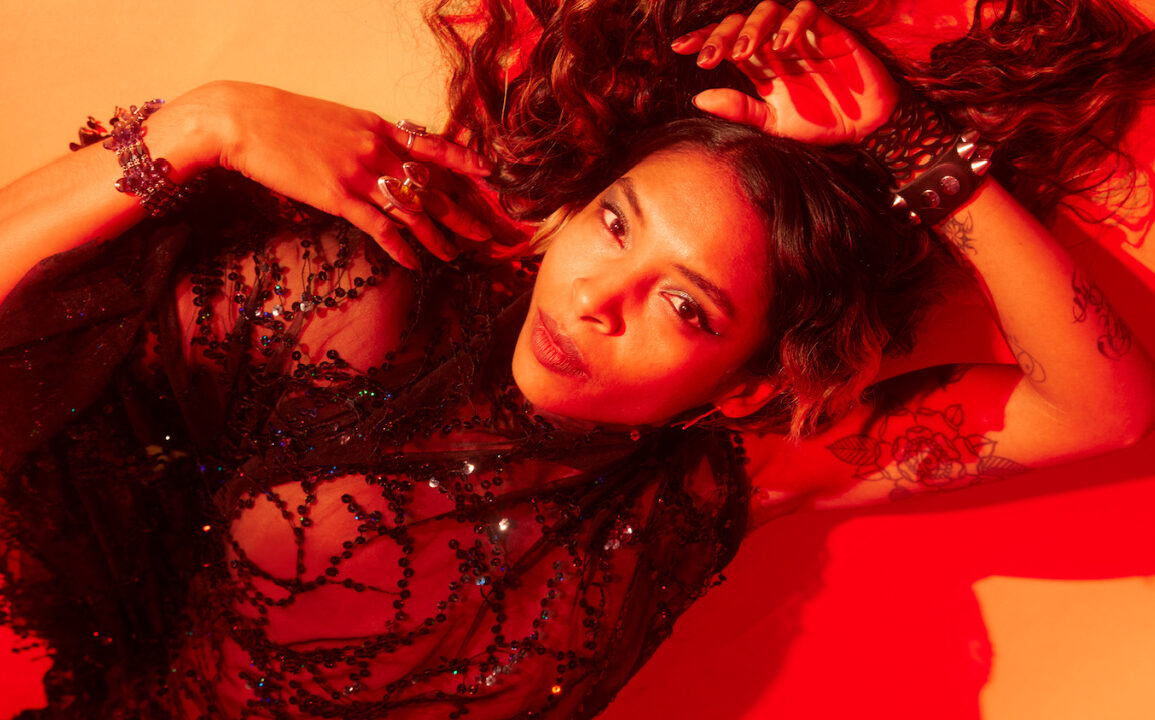
Photo Credit: Katie Lovecraft
Chrystia Cabral, a.k.a. SPELLLING has released her latest album Portrait of My Heart earlier this year. To find out more about this rock-embedded and highly personal effort, we chatted with Cabral in person prior to her Berlin concert at Lido on June 16.
I have observed that, like you, there are many Taurus musicians out there. It almost seems like they are taking the lead in that field among the 12 signs. Did you also notice that before?
Chrystia Cabral: Well, that’s interesting. I know Kehlani is a Taurus. She also has Bay Area roots. I love everything she stands for. I know Adele’s a Taurus, and Stevie Wonder and I have the same birthday.
Cool. Trent Reznor is also a Taurus.
I didn’t know that. OK, I’m excited! If there’s something I’ll ever get cancelled for, it’s for being a Taurus supremacist. (both laugh) I love Tauruses. I think we’re such good, reliable people. But when it comes to touring, I’ve always felt like it was not a good sign to be in this industry. I’ve kind of come out the other side of that. I’ve found ways to find something that’s grounding about the touring life. Anyway, I think we’re inclined to have a sensual understanding of the world. Probably that blends to good art making and good singing and all of that. But I feel like there are other signs such as Sagittarius that are such powerhouse personalities.
As a Sagittarius rising, thanks.
I’m learning so much about all that recently. Before I started making music, I thought that you had to be this you’re-scared-of-nothing personality to be a performer, and I’m now like, “Oh, the artists that I like and love are actually really shy people, or actually have a lot of stage anxiety or social anxiety!” Then I’m like, “Oh, OK, I’m not the only one.” It’s actually a majority of artists and performers who are freaked out by this all the time.
I would say that ahead of all the negative stereotypes of being slow and all, you Tauruses are very determined people.
It works out in the end! (laughs) I have to do things slowly. That’s the thing I learned. I was trying so hard to keep up with the pace of everyone else, but it’s actually not lending to what makes my art, my craft, what it is. I have to do it this way. I have to do it my way. So yeah, it’s gonna take a long time, but I’ll get there.
I really liked your new album Portrait of My Heart. When you consider the production process of the album, do two tracks stand out, one being the easiest and one hardest to create?
I think the easiest one was “Mount Analogue.” The lyrics took a while, but the flow of the song was very natural. It wasn’t ever this big question mark as far as how the song and the narrative would happen with the music. It was very easy. The lyrics usually are the last part anyway, and even then they came to me, once I tried to just riff on it, it just came out very naturally.
The hardest one was probably “Waterfall” because it meant so much to me and it felt so stuck. For a long time, everything was wrong about that. I was like, “This shouldn’t even be a rock song.” I tried different speeds and different genres, different ways to play with the rhythm, and nothing felt quite right, literally up until the day we’re mixing it. I was like, “This is wrong, something’s not right about this.” That was because it didn’t have a chorus.
You didn’t have that until the last minute?
Until the very last minute. I left the mixing studio and was driving around and listening to it over and over. Instead of the vocal line, instead of me singing it, it was the violins, super loud. I’m like, I’ll just take that out and I’ll sing it instead. Once I started to sing it, the lyrics came together and all right, I could finally be at peace. But it took so long. (laughs)
It works out in the end.
It works out in the end!
There is a quote that I really love: “Art is never finished, merely abandoned.”
Yeah!
But in this instance, it’s probably good that you didn’t abandon the song until the last minute. (both laugh)
Yeah. It’s just about abandoning it at the right time.
You mentioned PoMH being more autobiographical than your previous records where you mostly developed personas of yourself, in a somewhat similar fashion to David Bowie and his personas. Have you ever looked back to an old song or an era and just thought, “Well, who is she?!”
No, not for any of the other music that I’ve written. I wonder about this album though. I do think about it because I’m wondering even now, looking back to six months ago or a year ago, is that the same person? Each song clearly and distinctly represents very specific things that happen in my personal life. So I do even now look at a song like “Drain” particularly, or “Love Ray Eyes.” These songs were very charged with changes in my identity and I can kind of laugh at them a little bit now, you know? Those feel more like a time capsule.
That makes sense to me. You mentioned in an interview that the title track originally had a much longer version until Rob Bisel deleted the first part and made it into the more mainstream rock banger we see on the album. Do you consider releasing earlier demo versions of the songs at some point?
Yeah, I still really like the demo version, and the line that got taken out. I remember him saying, “This reminds me of a Motown arrangement.” There’s an idea that happens that never comes back again, and he’s like, “It just doesn’t fit in my pop brain to do that,” and I was like, “But that’s the best part about it!” Then I saw what it did and I was like, “OK, I understand.” But then I still really love when music has an art rock style, like Genesis, or the stuff that infuses soul music where you can really just go there and have these motifs or riffs that don’t ever occur. I think it’s really cool. So I like the synth line that got taken out and I’m working on remixes that will bring back the deleted parts of the demos that I really like.
That sounds exciting. Do you have a favorite David Bowie album, or an era?
Let me think about that. I love David Bowie, but it’s hard to see what my favorite album is. He’s not an artist that I’ve listened to album by album, but I do love Blackstar and like the music that he put out closer to the end of his life. I feel like it was so prophetic, almost like he knew he was looking at his own mortality.
Yeah, it was very personal and autobiographical.
Yeah, and I think that’s kind of similar to David Lynch, their work feel very prophetic. I don’t know, the idea that, so late in their career, they’re still making things that feel so new is great. So I really admired that album. I remember when that song came out, I was thinking, “How is he still doing this?” (laughs) So I love that album a lot.
While we are talking about my two favorite Capricorn Davids, do you have any favorite David Lynch film?
Oh yeah. I think in my head Mulholland Drive recently outranked Eraserhead, which used to be my favorite. I went to go see it at the Roxy Theatre in San Francisco, because it was David Lynch week and they were playing all of his movies. I saw that one twice and just seeing it on a big screen really made that number one. I love looking at all the theories of what’s happening in the film. There’s this website that’s really hokey looking and it has all these different conspiracy theories on who the character behind the dumpster is or who they represent.
And there will never be an explanation.
No explanation. Yeah. But I love the idea of the doppelganger that he plays with a lot, which also connects to David Bowie, because I think he plays around with that, too. I read this quote by David Bowie telling that when you create as an artist, you almost create a version of yourself that you don’t like. You put all the things into it that you hope to defeat, and then you kill it. That’s how you become a superstar. (laughs) It’s also weird how he was into some dark magic and occult sort of ideas. Anyway, I just thought the idea of creating this doppelganger and destroying it was really fascinating, because there’s all this lore about the doppelganger, and it’s like the version of yourself that you are insecure about, it’s your alter ego. So I think about that all the time. I think Mulholland Drive is very much like that. There is a version of your life and then your dream version of it. And they kind of fold in on each other in the middle of the movie.
Your answer sort of naturally connect to my next question: I want to ask you about dreams because that’s a topic of fascination for me. How often do you dream and what do you think was the latest wild dream that you had?
Oh my God. I haven’t been dreaming as much as I usually do. Normally I have a lot of dreams while I’m on tour. It’s been so minimal, but I used to keep a dream journal and when I do that, it makes remembering them so much more fluid. I have recurring dreams about whales or sea creatures a lot. There’s always whales, and lately it’s changed from that to these water babies. I don’t know what’s going on with these water babies, but I think it has to do with creativity. It’s these little creatures I find on the water and they look like Cabbage Patch Kids, these little dolls, but they’re scary. They have wrinkly baby faces, but they look very old. I’m trying to take them out of the water and I’m like, “What?! Who abandoned them?” I’m frantically trying to take them out of the water and adopt them. So I don’t know what’s going on with that. (both laugh) Maybe you can interpret that for me.
I don’t know. (laughs) I have to think about that.
It’s like foraging mushrooms, and then I’m like, “Oh, these are actually alive.” It’s happened maybe two or three times, this water baby dream.
What do you think is the most interesting, weird item in your music collection?
My collection is kind of sad right now. I got rid of a bunch of stuff. Well, it’s not sad, but it’s just that after I finished PoMH, and I do this after an album cycle, I wanted to get rid of stuff and to make space for something new that’ll be the new soundboard for the next album.
You can also count things you used to have.
I love the OB-6 synthesizer. I used it on “Alibi”, and all the more pop punky songs. It’s really, really strong. I think it was a little too distinct for me to keep in my collection, so I sold it, but I just love that synth. I got it because I like Boy Harsher a lot and Gus (Muller) uses it in a lot of their songs. So I’m like, “Oh, I’m going to get that.” That’s usually how I find stuff: On a video by Blood Orange, there were his friends just hanging out in his apartment and he uses the 6-track drum machine. I loved how it sounded, so I bought it. That’s how I shop for gear.
Speaking of Blood Orange, maybe it’s time for some Turnstile praise as well. I’m gonna see them live in a few days. Have you seen them before?
That’s awesome! Yeah, I opened for them for a few shows. We were just in London, and then they were there the day after. Brendan (Yates) and I are friends. He’s great.
Let’s imagine we’re at a Musicians Theme Park 100 years from now, where every artist or band featured has their own memorial stone with a certain lyric by them written on it. Which one of your lyrics would you like to see written on your stone?
“The body is the law.”
Wow.
That’s easy.
I think that’s the fastest answer I’ve got from anyone so far. (both laugh)
Well, it feels very final.
You can check out SPELLLING’s Bandcamp profile here.